
Rider Guide · Updated 21 August 2026
NSW E-Bike Rules for Delivery Riders
As of 21 August 2026, a legal electrically power-assisted cycle can use NSW roads and public paths if it meets the current power and assistance limits. Food-delivery riders also have separate PPE and training-record duties. This guide separates road legality, workplace requirements and battery safety so you can check each one before a shift.
Book a Rental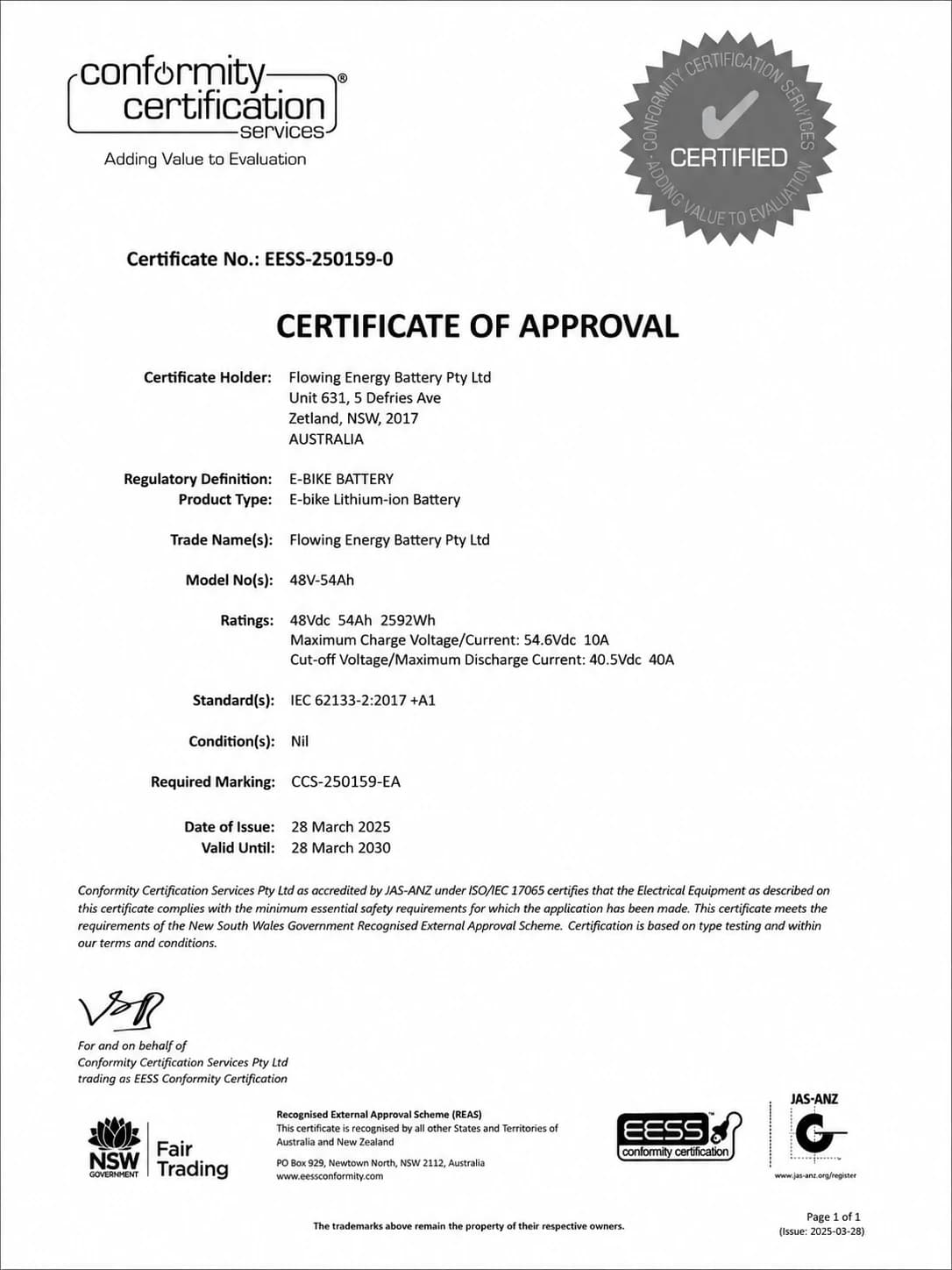
Which e-bikes are legal on NSW roads and paths?
The current NSW rules describe two permitted categories. The first is a power-assisted pedal cycle with combined motor output up to 200 watts, a total weight below 50 kg including batteries, an adjustable seat and no ability to move using the motor alone. The second is an electrically power-assisted cycle with maximum continuous rated power up to 500 watts.
| Current NSW category | Power condition | Motor-assistance condition |
|---|---|---|
| Power-assisted pedal cycle | Up to 200W combined output | Cannot be propelled only by the motor |
| Electrically power-assisted cycle | Up to 500W maximum continuous rated power | Assistance reduces above 6 km/h and cuts out at 25 km/h or when pedalling stops above 6 km/h |
A software setting does not make an overpowered bike legal if the vehicle is capable of operating above the permitted rating. NSW also says throttle-only devices that can propel the bike without pedalling are not legal on public roads and paths, apart from the limited low-speed assistance described in the rules. Check the current wording on the NSW Government legal e-bike page.
The announced 2029 rule change
The NSW Government announced a transition toward the European EN 15194 standard. Its current FAQ says e-bikes used on NSW roads will need to comply with EN 15194 from 1 March 2029, with maximum continuous rated power capped at 250 watts. Bikes between 251 and 500 watts can remain legal during the transition only when they meet the rules that apply now.
This is a changing area. Do not rely on an old retailer listing, social-media post or motor sticker alone. Recheck the current NSW e-bike FAQ before buying, renting or modifying a bike.
Do you need a licence or registration?
A rider does not need a driver licence or vehicle registration for a bike that fits a legal NSW e-bike category. If a device exceeds the limits or is modified so it no longer fits the definition, it may be treated as an unregistered and uninsured motor vehicle. That can change the penalties and insurance position substantially.
Rental does not transfer the road-rule responsibility away from the rider. At pickup, ask to see the motor rating and how assistance and any walk-assist function behave. Do not alter the controller, speed limiter, throttle, motor, battery or software.
Rules that apply specifically to food-delivery riders
NSW workplace rules sit on top of ordinary bicycle road rules. Food-delivery platforms must provide prescribed high-visibility PPE and induction training. Riders must wear the supplied high-visibility outer garment and use the supplied reflective food bag or container while delivering. Riders must also carry the training verification record and make it available to SafeWork NSW or NSW Police when requested.
Your rental may include a helmet and insulated delivery bag, but do not assume those replace the PPE your delivery platform is required to supply. Confirm the platform’s current equipment and training process before accepting orders. The official duties are summarised in the SafeWork NSW food-delivery legislation guidance.
Pre-shift road-safety check
A short check before every shift should cover:
- helmet fit and the platform-supplied high-visibility PPE;
- front and rear brakes, tyre pressure and visible tyre damage;
- steering, frame, seat, pedals and wheels;
- front and rear lights, reflectors and bell;
- battery mounting, cables, display and charger condition;
- delivery bag attachment and secure cargo placement; and
- lock, phone mount and enough charge for the planned route.
Stop riding if braking, steering, tyres, wiring or the battery does not look or behave normally. Contact the rental team before trying to repair or modify the bike yourself.
Charging an e-bike battery safely
NSW Fair Trading and Fire and Rescue NSW advise using only a compatible approved charger, charging on a hard non-combustible surface, keeping batteries away from exits and flammable materials, and disconnecting once charging is complete. Do not charge while sleeping or away from home.
Stop using or charging a battery that is swollen, leaking, cracked, dented, punctured, unusually hot, smoking, giving off vapour or has been exposed to water. Move away from immediate danger and call 000 if there is fire, smoke or a threat to people. Do not put an e-bike battery in household rubbish.
Read the full official guidance from NSW Fair Trading and Fire and Rescue NSW.
What the EESS certificate does—and does not—prove
The 48V 54Ah battery certificate displayed by E-Bikes Express is EESS-250159-0. It lists the required marking CCS-250159-EA, the holder Flowing Energy Battery Pty Ltd, and IEC 62133-2:2017+A1. It was issued on 28 March 2025 and is shown as valid until 28 March 2030.
A battery certificate is evidence about the listed battery model; it does not by itself prove that the complete bike, motor output, controller settings or road use complies with every NSW rule. Those are separate checks. Ask the rental team to identify the exact bike configuration supplied at pickup.
Sources and editorial note
This guide was prepared by the E-Bikes Express team from official NSW Government, SafeWork NSW and Fire and Rescue NSW material. It is general information, not legal advice. Rules and enforcement can change; the linked official pages are authoritative.
- Choosing a legal e-bike — NSW Government
- E-bike FAQs — NSW Government
- Food-delivery rider legislation — SafeWork NSW
- Lithium-ion battery safety — NSW Fair Trading
- E-bike battery safety — Fire and Rescue NSW
Looking for a rental setup? Compare the Sydney delivery-rider e-bike plans or review the E-Bikes Express safety notice.